(QMUL × Divergent Thinking)
During Neurodiversity Celebration Week, we hosted an online roundtable focused on a simple question: how do we turn autism-focused co-design research into practical training and support that organisations will actually use?
The session was co-hosted and facilitated by Divergent Thinking (Nat Hawley), a UK consultancy specialising in practical neuroinclusion for workplaces, alongside Professor Nelya Koteyko and Dr Simona Manni at Queen Mary University of London.
This roundtable built on the Co-Designing online platforms with autistic users toolkit, developed through the Autistic Adults Online research programme, and explored what it takes to move from a published resource to real-world adoption across digital workplace tools and online communities.
Why we ran this session
Toolkits are valuable, but in real organisations, PDFs rarely translate into day-to-day practice without scaffolding: clear ownership, practical examples, templates, and training formats that fit into busy environments.
This session was designed using a “toolkit → adoption” lens: turning evidence into repeatable templates, training modules, and implementation steps that teams can apply across platforms (e.g., Teams, SharePoint, intranets, community spaces, public-facing pages).
Importantly: we weren’t rewriting the toolkit. The goal was to gather structured input on:
- what lands well,
- what blocks adoption,
- and what kind of training/resources would actually help organisations implement the insights.
Who attended
Interest exceeded expectations: 165 people registered for the event. Around 50 people attended live, and 34 participants actively contributed via the interactive activities.
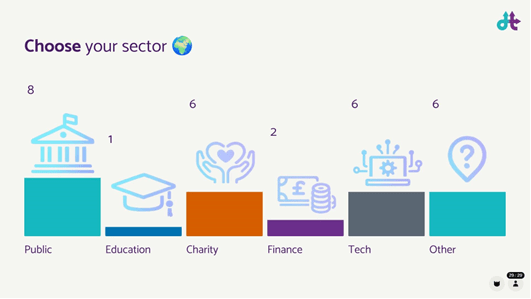
Attendees represented a wide mix of roles and sectors, including:
- trainers and facilitators,
- ND/disability and EDI leads,
- public sector and education professionals,
- charity and third sector teams,
- and people working across digital, comms, and service delivery contexts.
This mix mattered: it meant the discussion wasn’t only about design theory — it was heavily grounded in implementation reality.
What we heard: consistent friction patterns
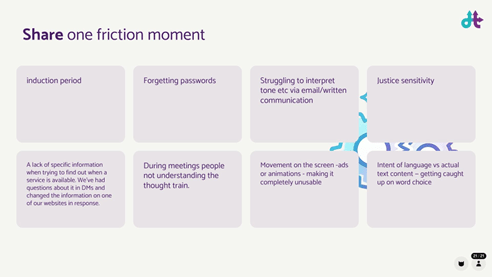
Even across different contexts (workplace platforms, public-facing services, online communities), participants described very similar friction points that autistic users commonly face, often leading to extra “coping effort” (double-checking, masking, disengaging, constant vigilance).
The strongest themes were:
1) Meaning and tone are often the biggest problem
Participants repeatedly described how ambiguity, implied expectations, and tone misreads create significant friction — especially in written, fast-paced digital spaces.
2) Sensory and cognitive overload is still everywhere
Movement (including GIFs and autoplay), cluttered layouts, visual noise, and “too much happening at once” came up frequently — alongside the need for user control (e.g., dark mode, reduced motion, clearer information hierarchy).
3) Audience uncertainty undermines trust
People highlighted how unclear privacy defaults and “who can see what” creates anxiety and discourages participation — across both internal and external platforms.
4) Content quality and hostility require governance, not just good intentions
Vague “be kind” messages aren’t enough. People want explicit rules, escalation paths, and predictable moderation.
What platforms should do more of
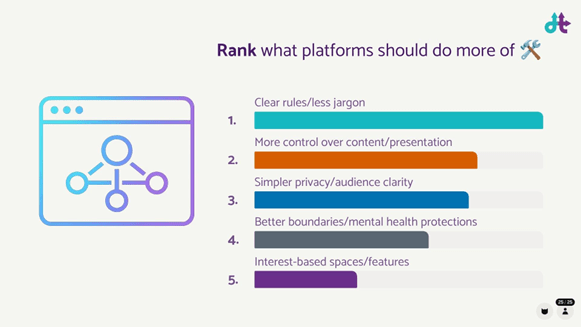
When asked to prioritise improvements that would most support autistic users, participants consistently favoured actions that make digital environments more predictable and controllable:
- Clear rules and less jargon
- More user control over content and presentation
- Simpler privacy and clearer audience controls
- Better boundaries and mental health protections
- Interest-based spaces that support purposeful interaction
A key takeaway: people were often asking for governance + clarity, not “more features”.
Why adoption fails (even when people agree)
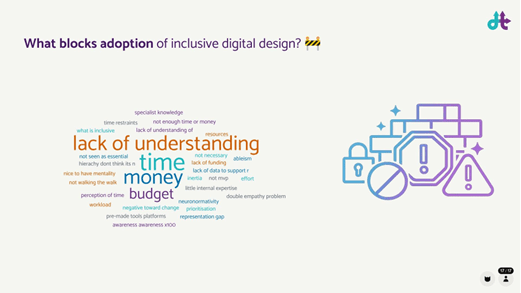
The barriers raised were largely non-technical. The most common blockers were:
- lack of time / competing priorities,
- unclear ownership,
- “nice to have” framing,
- minimum-compliance thinking,
- lack of leadership sponsorship,[Text Wrapping Break]
- and limited access to lived experience input.
Participants also surfaced familiar organisational pushbacks:
- “Where will the funding come from?”
- “Why change something that’s working?”
- “We’ve met minimum requirements — why do more?”
- “We need to ship the MVP first.”
- “We can’t meet everyone’s needs.”
These aren’t just complaints — they’re training requirements, because any resources we develop need to anticipate and answer these objections.
What kind of training/resources would actually be used
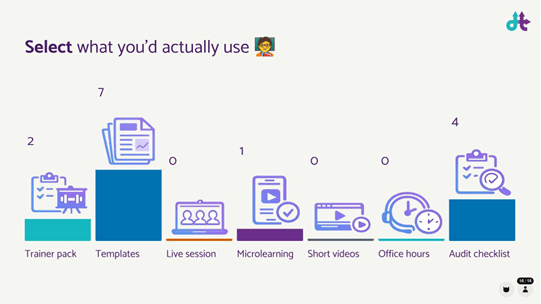
A very strong message emerged: organisations need implementation scaffolding, not another long document.
The most requested formats were:
- templates and checklists (rules, onboarding, “how this works”, privacy explainers),
- train-the-trainer assets (slides + scripts that internal teams can reuse),
- microlearning (short modules in 15–20 minute chunks),
- and real examples (before/after patterns, case scenarios, common friction moments).
There was also clear feedback that training must be multi-modal by default (e.g., transcripts, accessible written materials, alternatives to video-only learning).
A draft module set to build around the toolkit
Based on the session themes, a practical training pathway could be structured around modules such as:
- Plain language + clear expectations
- Reduce overload (clutter/motion/noise)
- Navigation + “how this works” guidance
- Healthier boundaries (“always on” norms)
- Fair moderation rules that work
- Privacy/audience clarity
- Tone, emojis/GIFs, and meaning misreads
The emphasis from participants: each module should produce something tangible (a template, a policy snippet, a config checklist, an onboarding pattern) — so teams leave with real artefacts, not just ideas.
What happens next
We’ll be using this session’s outputs to shape:
- a draft training pack outline (formats, modules, templates),
- a set of practical adoption supports (checklists, example outputs, implementation prompts),
- and guidance on measurement that centres autistic feedback while still offering simple organisational metrics.
Useful links and resources
- Research website: autisticadultsonline.com
- Toolkit (PDF): Co-designing Online Platforms with Autistic Users
- Evidence cards (download): GitHub – Evidence cards
- Design cards (download): GitHub – Design cards
About the facilitator
Nat Hawley supported delivery of this roundtable as part of the collaboration between Queen Mary University of London and Divergent Thinking.

